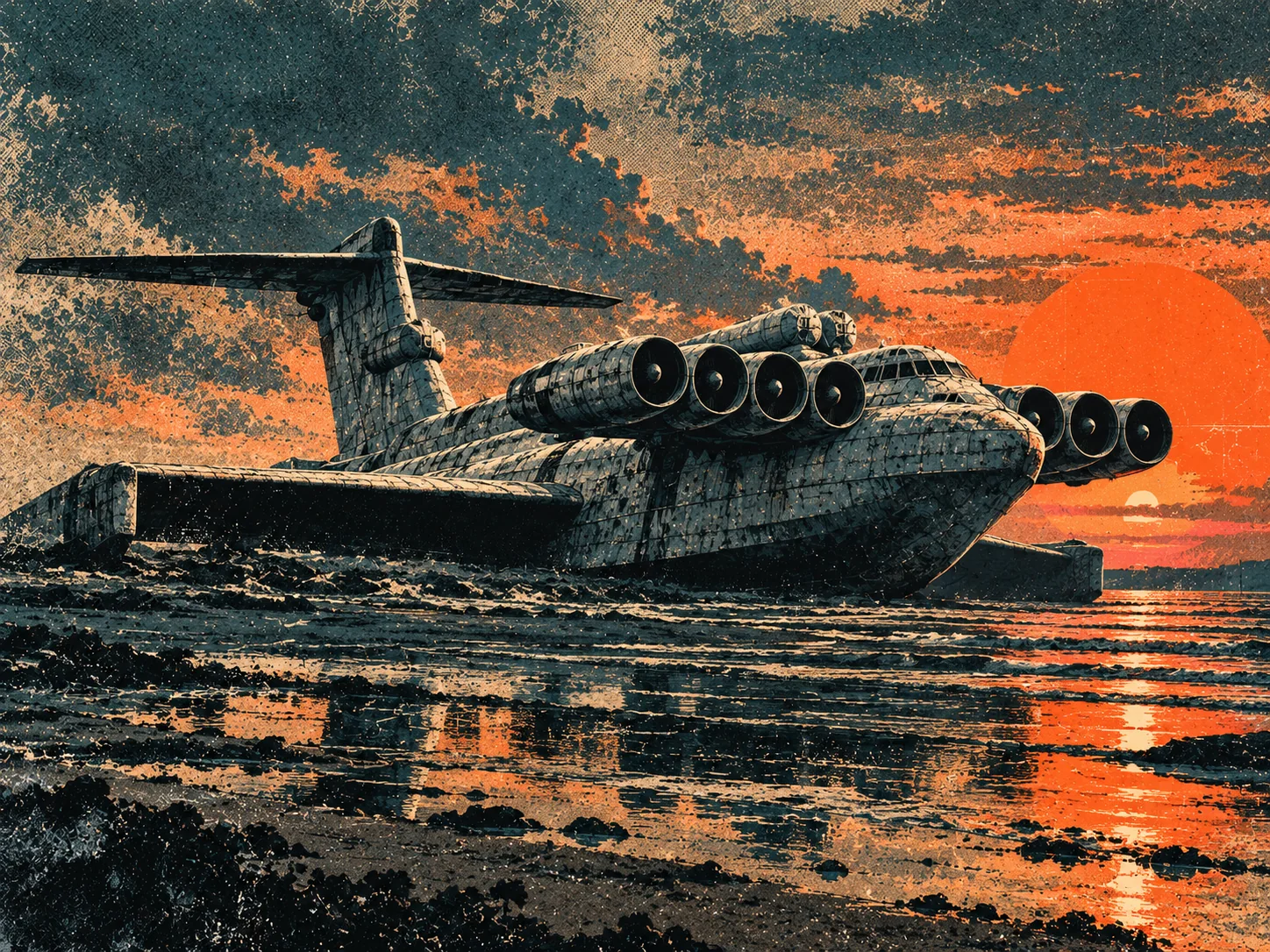
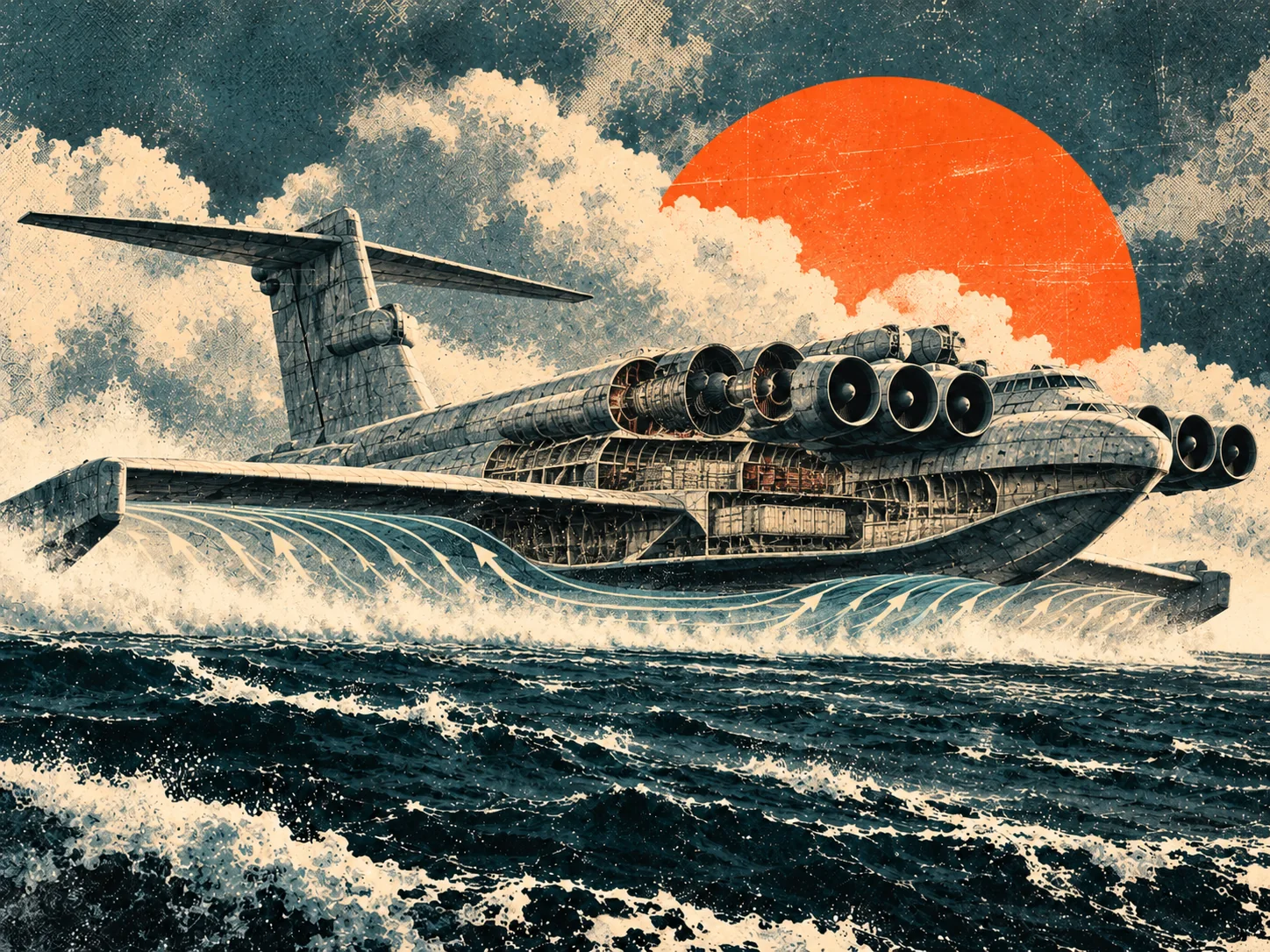
In the 1960s, American intelligence analysts studying satellite photographs of the Soviet Union encountered something extraordinary.
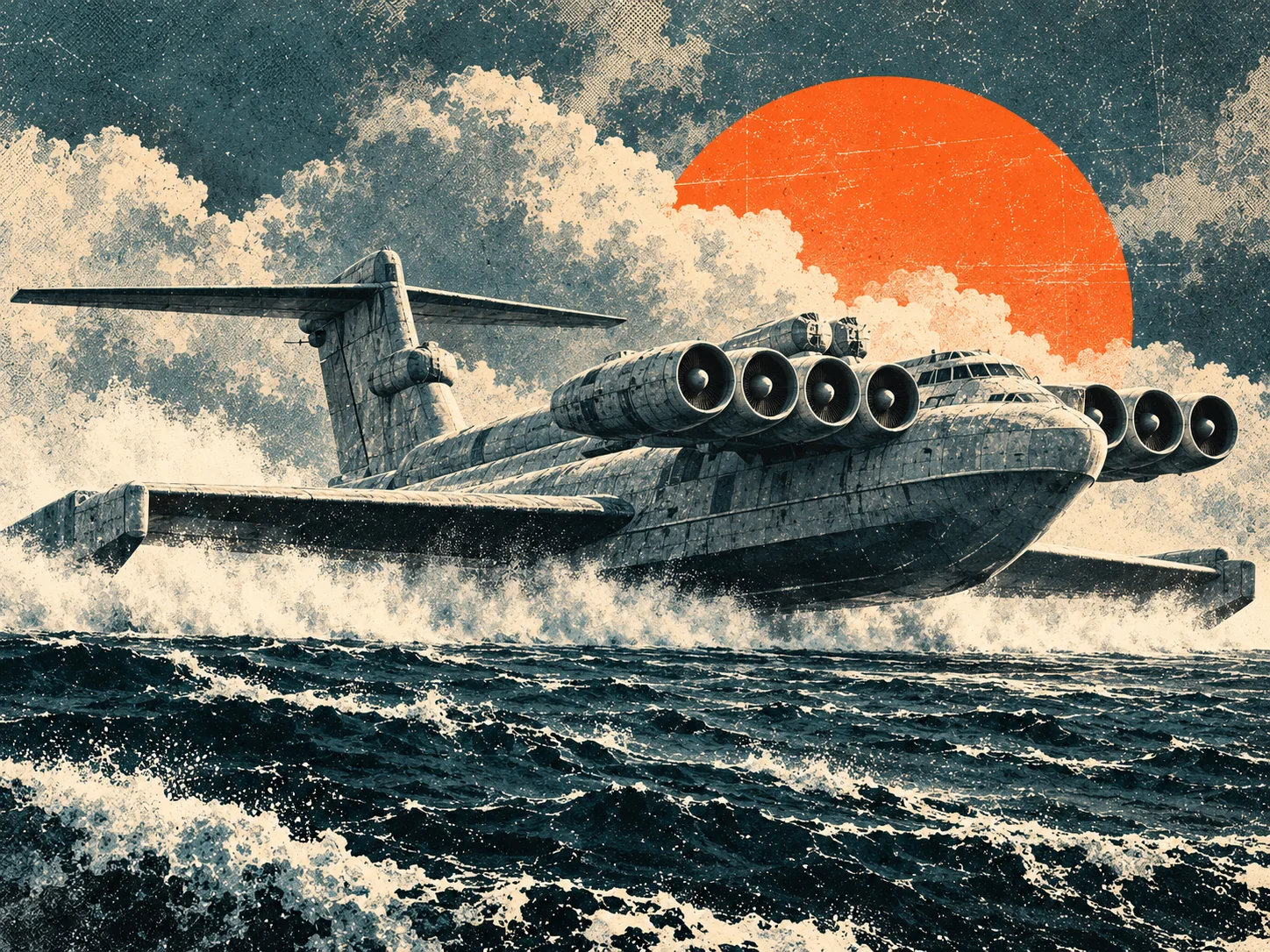
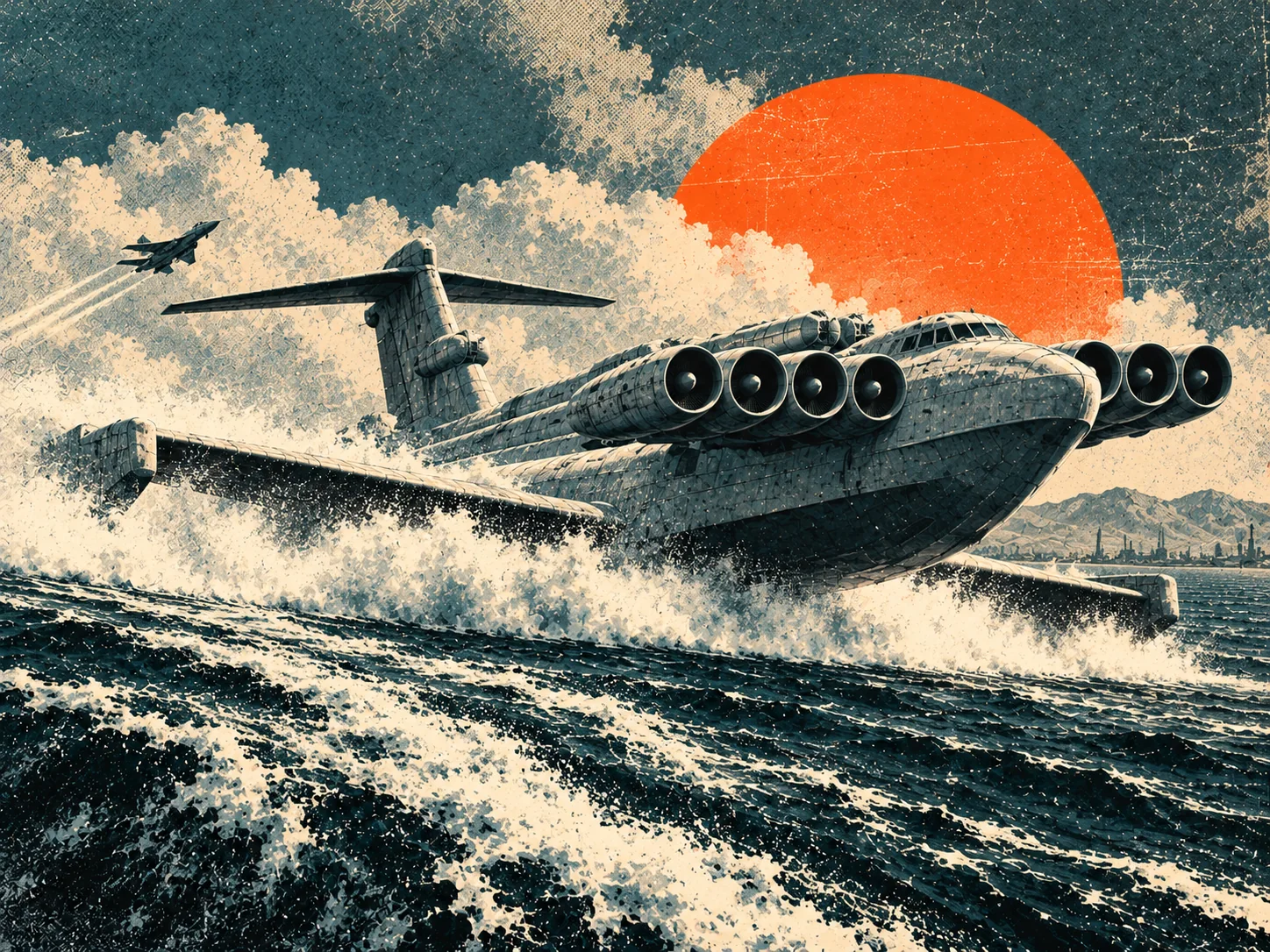
On the Caspian Sea was a machine with the hull of a ship, the wings of an aircraft and ten enormous jet engines. It was nearly 100 metres long, yet its wings appeared astonishingly short for something supposedly capable of flight.
The letters painted on its hull were KM.
The Americans came to know it as the Caspian Sea Monster. 1,6
It looked like something from a science-fiction film. But the machine was real, and the Soviet Union had invested years of engineering research into making it work.
The question was not simply whether something so enormous could fly.
It was whether it could change warfare.
An engineer who wanted ships to fly
The story began with a shipbuilding engineer named Rostislav Alexeyev.
During and after the Second World War, Alexeyev developed hydrofoils: vessels that rise partly out of the water on underwater lifting surfaces, reducing drag and allowing much greater speeds than conventional boats.
His work helped produce successful Soviet passenger hydrofoils.
But Alexeyev believed there was another step beyond the hydrofoil.
What if a vessel could leave the water entirely without having to climb thousands of metres into the sky?
By the late 1950s, his team was experimenting with a technology known in Russian as the ekranoplan, or screen plane. 3
The underlying phenomenon was already understood by aerodynamic researchers.
It was called ground effect.
The science of flying above the waves
When an aircraft flies close to a surface, the airflow around its wings changes. The proximity of the ground or water reduces induced drag, potentially allowing the wing to generate lift more efficiently.
The effect becomes particularly significant when the wing is very close to the surface.
NASA’s published aerodynamic research demonstrated increased lift-to-drag ratios in wings operating close to the ground. 4,5
For an engineer interested in moving heavy loads quickly, the possibilities were enormous.
An ekranoplan could travel at aircraft-like speeds while remaining close to the sea, potentially transporting substantial cargo without the same aerodynamic requirements as a conventional aircraft flying at altitude.
There was a catch.
The advantages depended on staying within the ground-effect region. Climb too high, and the aerodynamic benefit diminished. Takeoff also demanded enormous power, especially for a heavily loaded machine.
The Soviet designers were not attempting to abolish the laws of flight.
They were attempting to exploit a very particular part of them.
The experiment that became a monster
In 1963, the Soviet Navy commissioned a huge experimental ekranoplan known as the KM — short for Korabl Maket, usually translated as ship prototype.
It was built at the Krasnoye Sormovo shipyard in Gorky, now Nizhny Novgorod.
The machine was extraordinary even by the standards of Cold War engineering. 1
Figures reported by William Pearce in Old Machine Press. Other accounts give different dimensions, including approximately 92 metres; the prototype changed during testing. Source 1 ↗
Eight Dobrynin VD-7 turbojet engines were mounted behind the cockpit. During takeoff, their exhaust could be directed downwards, helping create additional pressure beneath the wings.
Two further engines were mounted near the tail for cruising.
The arrangement was unlike almost anything the world had seen.
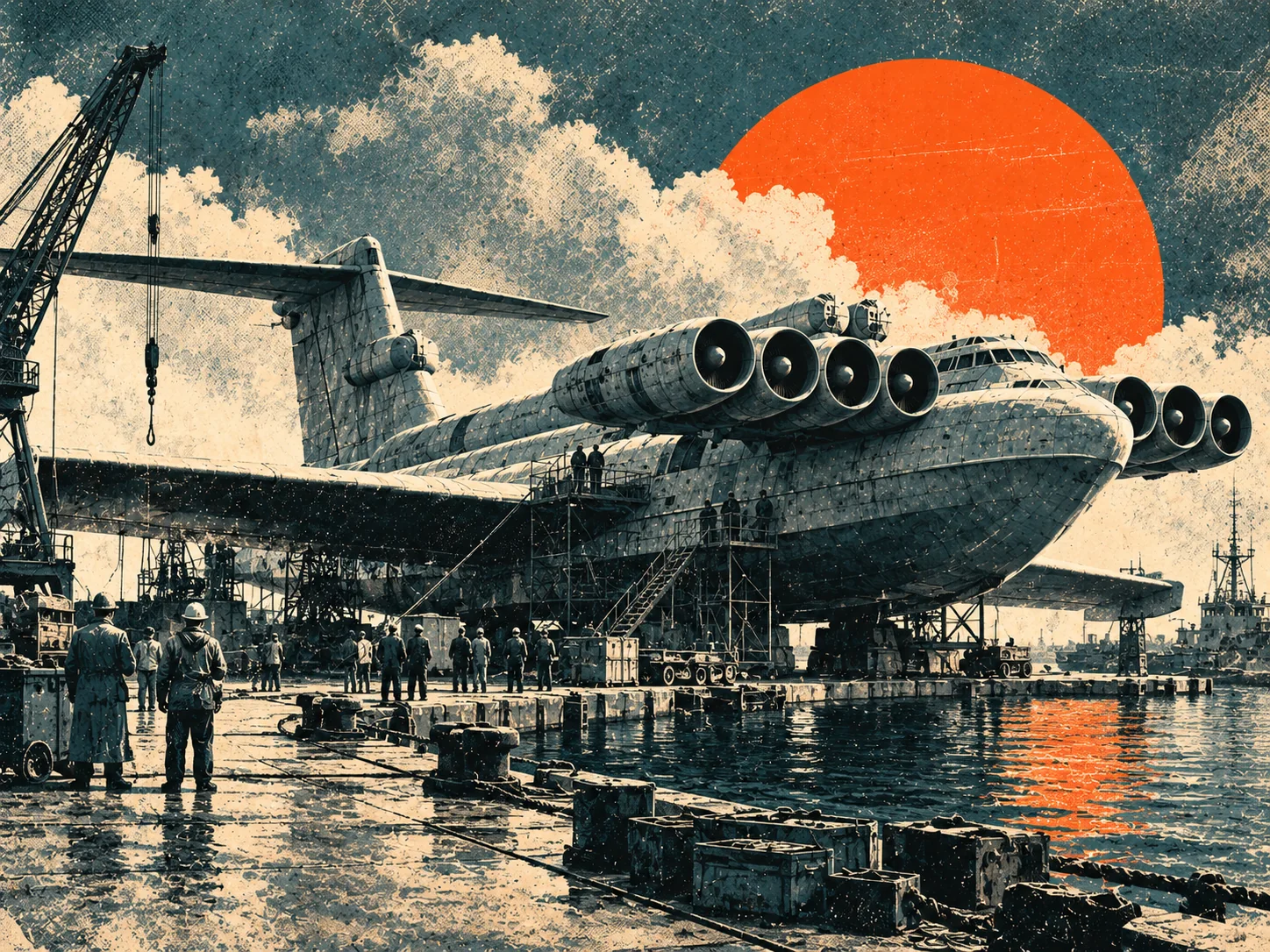
In June 1966, the KM was launched onto the Volga River and moved towards the Caspian Sea. To conceal the enormous experimental vehicle, its wings were removed for transport and the journey was conducted under cover.
At the testing base near Kaspiysk, engineers reassembled the machine.
Then came the moment of truth. 1
When did the monster first fly?
The KM began trials in October 1966.
But exactly when those trials became its first flight is less straightforward than many popular accounts suggest.
Technical historian William Pearce describes tests beginning on 18 October 1966, during which the craft rose onto the water’s surface at high speed without becoming fully airborne. His account identifies 14 August 1967 as the first true sustained flight.
According to that account, Alexeyev himself was at the controls. The flight lasted approximately 50 minutes and reached around 450 kilometres per hour.
Other published histories date the first flight to October 1966. The discrepancy is not fully resolved by the sources reviewed for this article. 1,3
Whichever convention is used, the achievement was remarkable.
A vehicle weighing hundreds of tonnes had demonstrated sustained, high-speed travel above the Caspian Sea.
And far above it, American reconnaissance satellites were watching.
The monster in the satellite photographs
American intelligence analysts discovered the strange Soviet vehicle through satellite imagery.
Its extraordinary proportions made interpretation difficult. With such short wings, it did not resemble a conventional transport aircraft. Yet its design clearly suggested something capable of travelling at remarkable speed.
The letters KM on the hull helped inspire the nickname Kaspian Monster, which eventually became the more familiar Caspian Sea Monster.
The precise naming story is generally recounted in later histories rather than established here from an original declassified naming record. 1,6
For the Soviet engineers, however, the KM was not a mysterious super-weapon.
It was a research machine.
Its purpose was to establish whether enormous ground-effect vehicles could be built, controlled and operated at speeds previously associated with aircraft.
And for more than a decade, the experiment continued.
The day the monster disappeared
The KM survived years of testing, modifications and experimental flights.
It did not survive 1980.
In December of that year, the machine was lost during a takeoff accident.
According to the detailed account published by Old Machine Press, excessive elevator input raised the nose too sharply. The crew did not recover the attitude successfully, and the machine stalled, rolled to the left and struck the water.
The crew escaped unharmed.
The damaged KM reportedly remained afloat for about a week before sinking into the Caspian Sea. The exact sequence is drawn from later technical reporting, not an independently examined Soviet accident report. 1
The world’s most extraordinary experimental sea-skimming aircraft was gone.
But its influence was not.
From experiment to weapon: the Lun
The KM had tested whether a machine of such enormous size could exploit ground effect.
The next question was whether the technology could become a practical military weapon.
The Soviet Union developed several other ekranoplans, including the troop-carrying A-90 Orlyonok.
But perhaps the most spectacular successor was the Lun.
Unlike the KM, the Lun was designed specifically as a missile carrier.
It was shorter than the original monster, at approximately 73.8 metres, and carried eight Kuznetsov NK-87 jet engines.
Its most distinctive feature was impossible to miss.
Mounted along its back were six enormous missile-launching tubes, designed for P-270 Moskit anti-ship missiles.
The Soviet planners envisaged a craft capable of travelling quickly across the sea, approaching naval targets at low altitude and launching powerful missiles. 2,3
Two machines. Two different missions.
| At a glance | KM | Lun |
|---|---|---|
| Purpose | Experimental research | Missile carrier |
| Length | About 97.4 m | About 73.8 m |
| Engines | 10 | 8 |
| Weapons | None | Six Moskit missiles |
| Outcome | Sank in 1980 | Preserved near Derbent |
Only one missile-carrying Lun was completed.
A second hull was developed towards a search-and-rescue configuration called Spasatel, but that machine was never completed for operational use.
The Soviet ekranoplan programme had produced astonishing engineering achievements.
It had not produced a fleet capable of transforming naval warfare. 2
Why the future never arrived
At first glance, the ekranoplan seemed to combine the best qualities of two worlds.
It promised the speed of an aircraft and some of the carrying capacity of a ship.
But the same unusual design that made it extraordinary also imposed serious limitations.
The vehicle needed suitable stretches of water for takeoff and operation. Sea conditions affected its performance. Its low-altitude operating envelope constrained where it could travel, while its specialised propulsion systems, maintenance requirements and fuel demands complicated routine deployment.
Most importantly, the technology was competing against systems that already worked.
Conventional aircraft could climb over obstacles and bad weather. Ships could remain at sea for extended periods and carry large loads efficiently. Helicopters could operate from confined locations.
The ekranoplan occupied a narrow space between them.
It could perform remarkable feats, but those feats did not automatically translate into an affordable, flexible military transport system.
There were political and institutional difficulties too. Alexeyev experienced serious conflicts within the Soviet shipbuilding establishment, and support for his projects fluctuated.
Smithsonian’s Air & Space reporting describes how technical challenges and political disagreements complicated the programme’s development. 3
No single explanation accounts for its decline.
The machine was real. The aerodynamic advantage was real.
The promised revolution never came.
The giant that found a final home
For years, the surviving Lun sat at the naval base in Kaspiysk, slowly deteriorating.
In July 2020, it was moved towards Derbent in Dagestan, where plans called for it to become the centrepiece of a military-themed museum and public park.
The journey was not straightforward.
The enormous craft spent years on the shore, creating images that circulated widely online: a Cold War missile carrier stranded on a beach, seemingly abandoned by the future it was built to create.
For a time, it looked as though the Lun might never receive the permanent home it had been promised.
But the story did not end there.
On 11 June 2026, the Patriot military-historical park opened near Derbent.
The Lun became its central exhibit, preserved as a monument to one of the Soviet Union’s most unusual engineering programmes. 7,8
The machine that once existed to race over the waves had finally come to rest.
Not as a forgotten wreck, but as something people could visit and examine.