
A 232-page plan to build the impossible
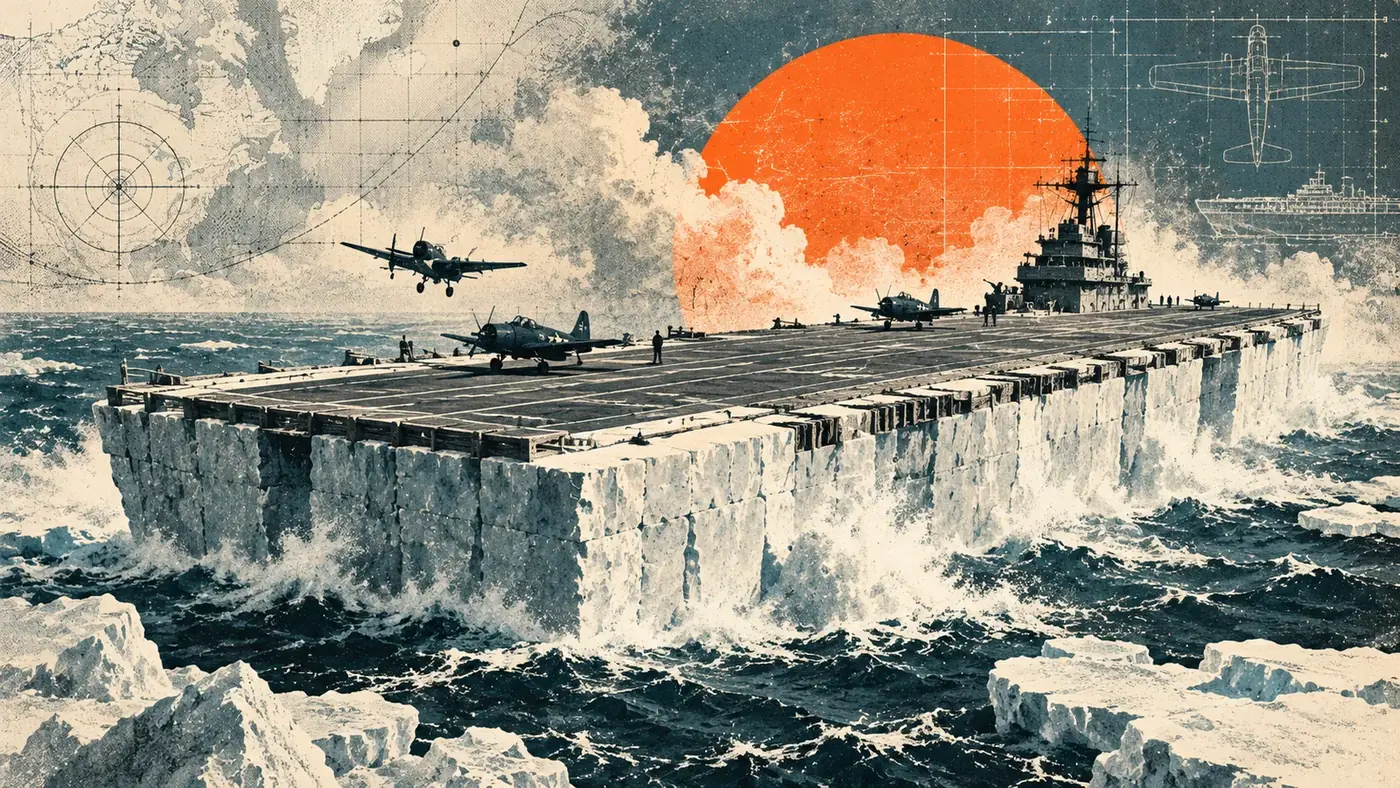
In the autumn of 1942, a British inventor named Geoffrey Pyke delivered a 232-page memorandum to Lord Louis Mountbatten, Chief of Combined Operations. Its central idea was almost unbelievable: Britain could build enormous floating airfields from ice. 1,2
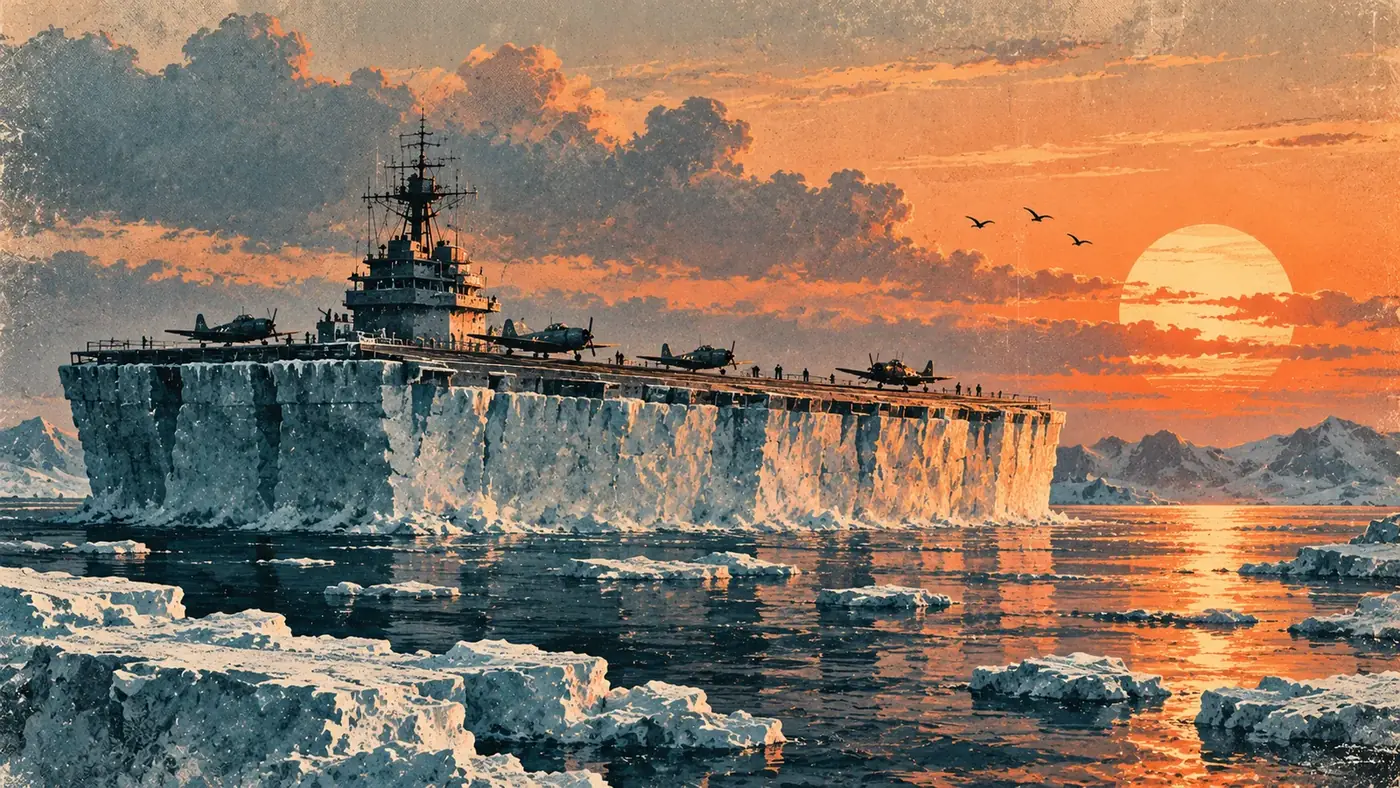
Pyke initially envisaged adapting natural or artificial icebergs, levelling their upper surfaces into runways and hollowing out space for aircraft. An iceberg could float, certainly. But could it support aircraft, survive ocean waves, resist enemy weapons and move under its own power? 1,2
Those questions should have been enough to discourage most military planners. Instead, the proposal attracted the attention of Winston Churchill.
As scientists examined the idea, natural icebergs and floating ice sheets proved unsuitable. The scheme grew into something more ambitious: a purpose-built, insulated and refrigerated vessel capable of carrying aircraft far from conventional bases. The project became known as Habbakuk, a name linked to the biblical prophet Habakkuk and a passage (Habakkuk 1:5) about a work so extraordinary that people would scarcely believe it. 1
It was an appropriate choice.
The problem no ordinary ship could solve
Britain's survival depended on the Atlantic. Convoys carried food, fuel, weapons and vehicles across an ocean where German U-boats threatened Allied shipping. Aircraft could help protect those convoys by finding and attacking submarines, but they were limited by range. Large parts of the mid-Atlantic lay beyond the reach of many land-based patrol aircraft, and convoys crossing that gap could find themselves without cover from above. 1,2
Conventional aircraft carriers were one answer, but they demanded vast quantities of steel, skilled labour and machinery, all already under immense wartime pressure.
Pyke thought the Allies might be overlooking an alternative. Ice was abundant and it floated. Large masses melted slowly when insulated. And in Pyke's calculations, making a given weight of ice took only a fraction of the energy needed to make the same weight of steel. Planners also considered how floating airfields might support operations in the Pacific, where land bases were hard to obtain. 1
According to the scientist Max Perutz, Churchill directed in December 1942 that research should proceed with high priority. The prime minister also recognised an uncomfortable reality: freezing enormous masses artificially could itself be a formidable undertaking. Nature would need to do much of the work. 1
Unfortunately, nature was about to prove less cooperative than Pyke had hoped.
The material that changed everything
Ordinary ice makes a poor structural material. It is brittle, unpredictable under stress, and prone to fracturing under heavy impact. For a small block, that is an inconvenience. For a proposed aircraft carrier, it could be catastrophic.
Then came a breakthrough. In Perutz's 1948 scientific account, the project's prospects changed in February 1943 after work by Herman Mark and Walter Hohenstein at Brooklyn Polytechnic. They found that mixing a small proportion of wood pulp into ice dramatically improved its mechanical properties. 1
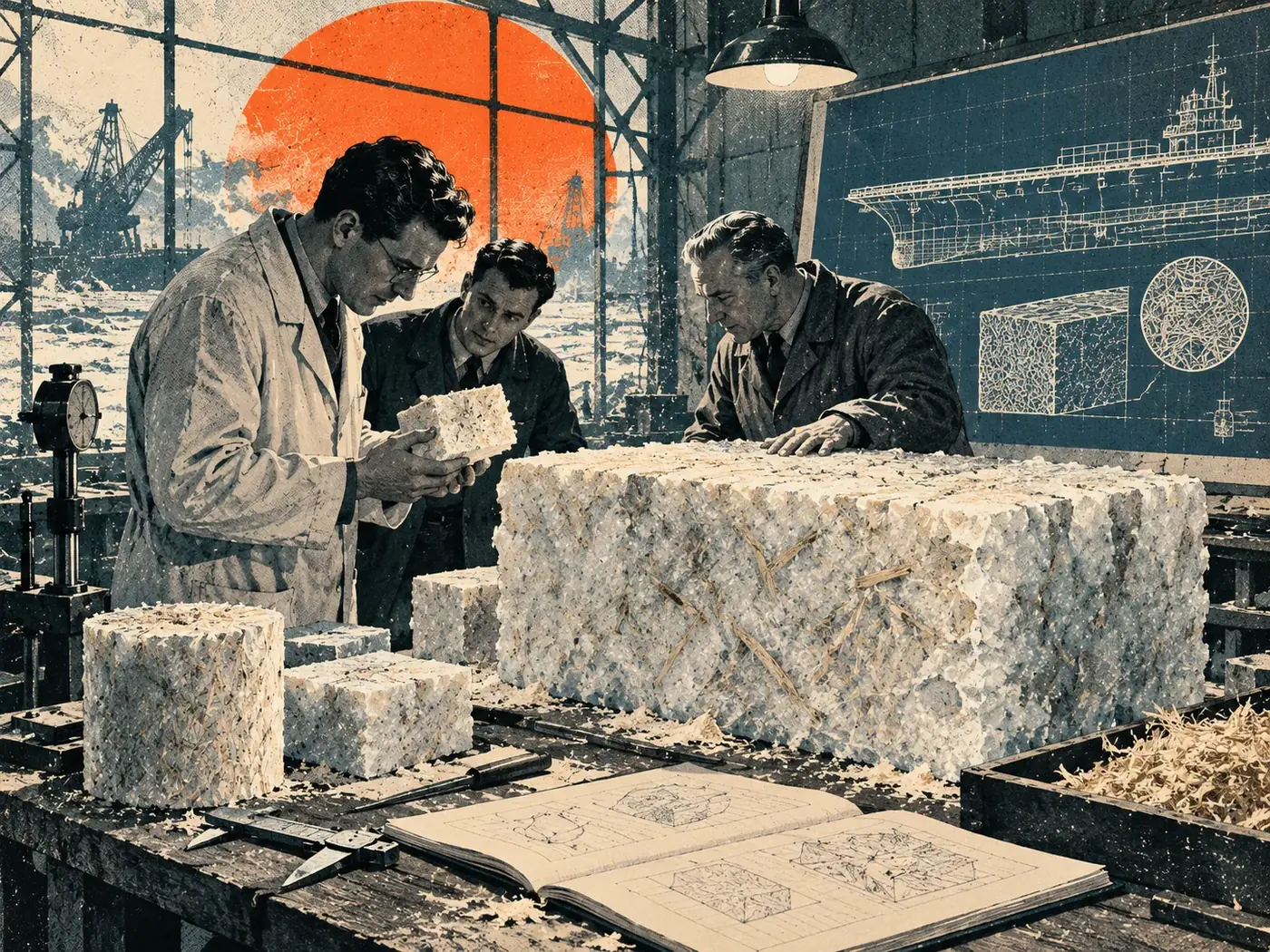
The reinforced material became known as pykrete, named in honour of Pyke, with a deliberate echo of concrete. Perutz and other researchers went on to test it for the British programme, some of them in refrigerated chambers beneath London's Smithfield meat market. 1
In one test Perutz described, a revolver bullet badly cracked an ordinary block of ice, while a comparable pykrete block suffered only a small crater. The wood fibres helped stop cracks spreading. Pykrete could even be machined. For a moment, it seemed researchers had found a cheap, abundant construction material with unusual defensive properties. 1
But pykrete was not indestructible. Tests indicated that underwater explosions could still damage it. And even where it resisted sudden impacts, it could slowly deform under sustained load, a process scientists call creep. For a vessel potentially weighing millions of tons, the danger was a structure that survived a projectile strike but gradually sagged under its own weight. 1
Perutz's research suggested that, for the proposed vessel and the materials tested, about −15°C was the highest working temperature that would avoid unacceptable deformation. That meant refrigeration plant, heavy insulation and an intricate network of cooling ducts. Britain was contemplating a warship that would have to operate, in part, like a floating industrial freezer. 1
The two-million-ton giant
The scale of the developed proposals was staggering. Perutz described one design with a runway about 600 metres long and 60 metres wide, walls around nine metres thick, and a displacement of roughly 2.2 million long tons. Sixteen refrigeration plants would keep it cold, and more than twenty electric motors would drive it through the water. 1
A speed of seven knots was considered the minimum needed to stop the vast craft drifting helplessly in the wind. That was a design requirement, not a speed any ice carrier ever achieved. Steering remained a particular headache: proposals using different propeller speeds and large rudders were investigated, but Perutz reported that no satisfactory solution was found. 1
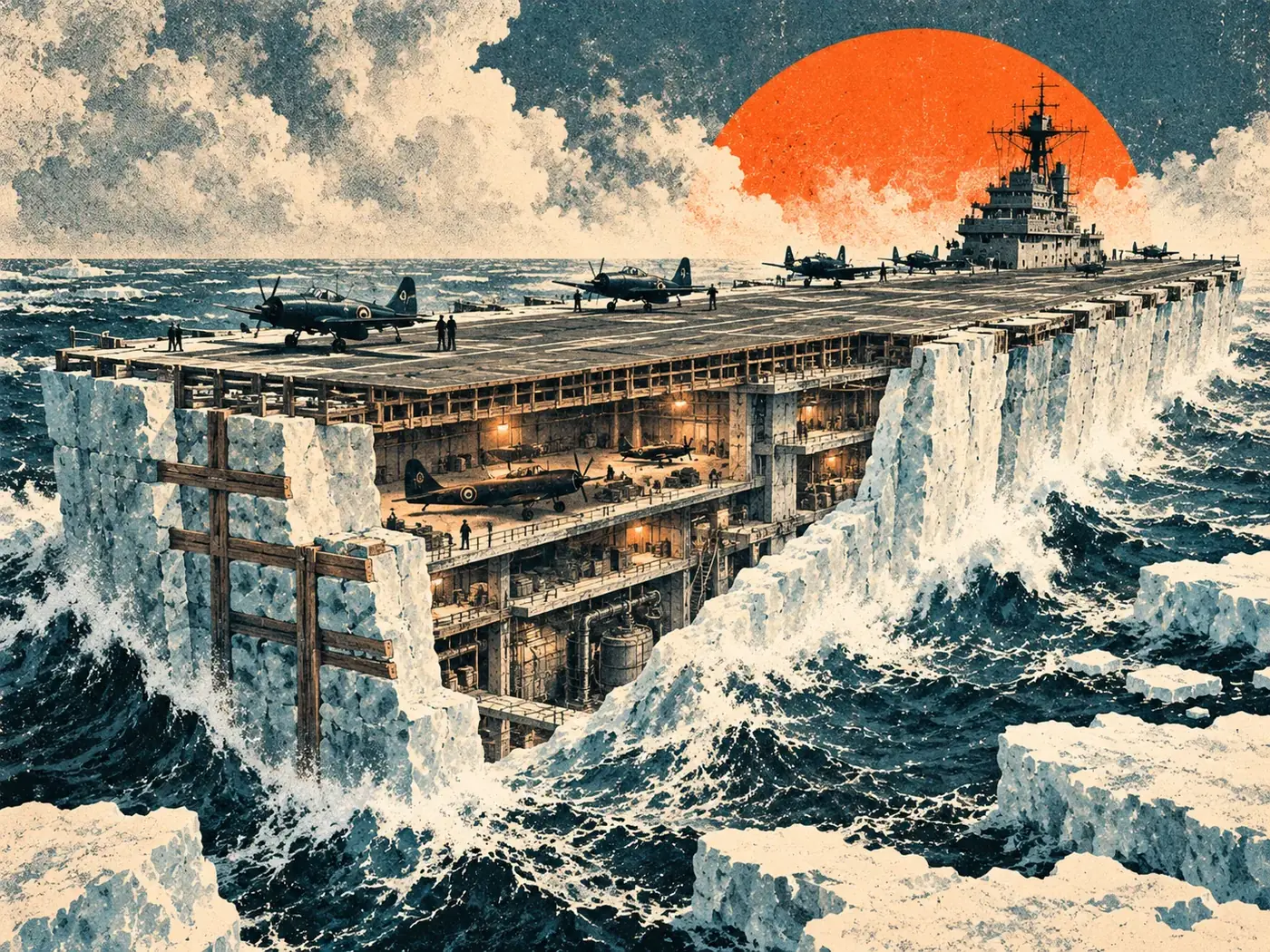
There was no single, finished Habbakuk blueprint. A British Chiefs of Staff memorandum of 18 August 1943, preserved in the official United States diplomatic record, describes three designs: Habbakuk I, a wooden vessel; Habbakuk II, which could be built in steel or pykrete at 1,700 to 2,200 feet long; and Habbakuk III, a smaller, faster steel design. What existed were proposals, experiments, competing designs and increasingly difficult questions. 5
Before going further, engineers needed evidence that a large frozen structure could survive outside the laboratory. For that, they turned to Canada.
The secret experiment in the Canadian Rockies
Patricia Lake lies near Jasper, Alberta, in the mountains of western Canada. Today it is a peaceful beauty spot. In 1943 it became the site of one of the strangest secret engineering experiments of the war.
Under Canada's National Research Council, workers built an experimental frozen structure about 60 feet long, 30 feet wide and 19½ feet high. It combined a wooden framework, lake ice, insulation, cooling ducts and refrigeration equipment, with a roof that made it resemble a boathouse. Historical records describe labour supplied by conscientious objectors from a nearby camp, and some accounts say those involved did not know the project's military purpose. 2,3
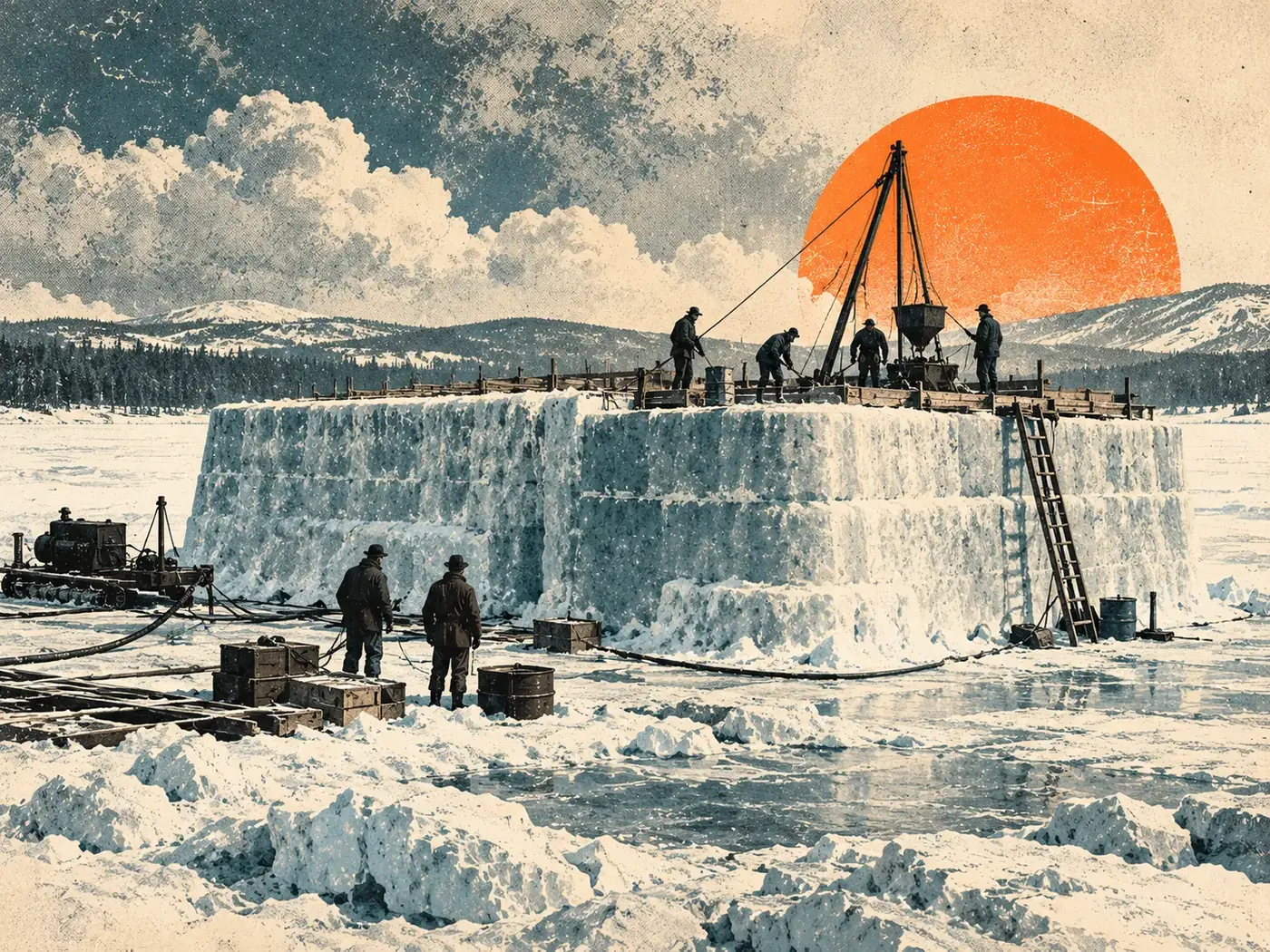
By April 1943 the refrigeration machinery was running. The team had built a substantial insulated ice structure and shown that mechanical cooling could help preserve it. 3
But many popular retellings overlook an important detail. The Patricia Lake model was built from ordinary lake ice, not the reinforced pykrete intended for the full-size carrier. Both F. J. McEvoy's historical research and Susan B. M. Langley's archaeological study support that distinction. 2,3
The experiment was real and its achievement significant, but it did not show that a gigantic pykrete vessel could cross an ocean, launch aircraft or withstand attack. It tested something narrower: building and preserving a large floating ice structure.
Even the refrigeration history contains an unresolved detail. McEvoy describes the model being kept frozen through the summer, while Langley reports that Churchill had been told by June that its machinery had been removed. Both accounts agree that the structure survived summer conditions before it eventually deteriorated, and the published sources examined for this article do not resolve the discrepancy. 2,3
There is no dispute about the central point. A secret frozen structure really did float on Patricia Lake. The aircraft carrier itself never did.
The gunshot that became a legend
The most famous story about Habbakuk involves a revolver. At the Quebec Conference in August 1943, according to published accounts citing Field Marshal Alan Brooke's wartime diary, Mountbatten demonstrated pykrete's resistance to gunfire. In the familiar telling, one shot shatters ordinary ice, and another, fired at pykrete, sends a bullet ricocheting around the room. Some versions say it narrowly missed senior officers; others name American Admiral Ernest King as the man endangered. 2,8
The details grow more complicated when another participant's recollection is examined. In his 1985 essay Enemy Alien, Max Perutz described a British demonstration involving Lieutenant Commander Douglas Grant, to whom Perutz had supplied samples of ice and pykrete. Grant later told Perutz that a bullet shattered the ordinary ice, but that when he fired at pykrete the projectile rebounded and struck the Chief of the Imperial General Staff in the shoulder, without injuring him. 4
Perutz was not an eyewitness. He was relaying what Grant told him afterwards, and his account should not automatically be treated as the same event as the Quebec episode attributed to Mountbatten. There may have been more than one demonstration, or details may have blended as the stories circulated. The accounts checked for this article do not settle which. The demonstrations have a basis in historical testimony; the precise details of the famous ricochets remain uncertain. 4
And Churchill's bath?
Another popular anecdote claims Mountbatten demonstrated the frozen material to Churchill while the prime minister was in the bath. It is exactly the sort of story that makes Habbakuk irresistible, and some retellings present it as settled fact.
The evidence is less secure. Later accounts repeat the story, but the sources checked here do not independently establish when it happened or what took place. Some versions place it in 1942, which sits awkwardly with Perutz's account of reinforced ice emerging in February 1943. That does not disprove the anecdote, but it means the familiar version should not be reported without qualification. For now it belongs among the attributed anecdotes, not the firmly documented events. 1
The real project needs no invented dialogue to be fascinating.
Why the ice aircraft carrier never sailed
By August 1943 the practical difficulties were overwhelming. Producing enough pykrete for a full-size vessel would require huge industrial facilities, the refrigeration systems would consume machinery and manufacturing capacity, and construction would demand substantial manpower. The Allies had other uses for those resources. 1,6
On 19 August 1943, the United States Chiefs of Staff gave a strikingly direct assessment. They considered Habbakuk II technically feasible given extraordinary effort and sufficient time, but judged that the likely military benefits did not justify diverting critical materials and labour from other essential projects. 6
That judgement cuts to the heart of the failure. The question was never simply whether an ice-based carrier could be built. It was whether it was worth building.
The war was also moving on. Longer-range aircraft and escort carriers were improving Allied air cover over the Atlantic, the Pacific campaign was reducing the anticipated need for giant floating airfields, and newer aircraft could require longer runways than earlier proposals allowed. A vessel conceived in 1942 risked being outdated before it could enter service. 1
The project did not end in one dramatic moment. Studies continued after Quebec, but the case grew steadily weaker, and the joint board was formally dissolved on 1 March 1944. No pykrete aircraft carrier was completed, no aircraft took off from one in battle, and no frozen warship ever confronted a German submarine. 2
The ghost beneath Patricia Lake
The Canadian experiment left something tangible behind. As the ice structure deteriorated, its framework and associated materials sank into Patricia Lake, and decades later archaeological investigations documented the remains. On 31 July 1988, volunteer divers installed an underwater commemorative plaque, supported by archaeological and diving organisations. An Alberta Underwater Council account reports that during a dive in 2009, one wall of the original structure was still standing. That is a historical observation, not a statement about the wreck's present condition. 3,7
What lies beneath the lake is not a hidden fleet of frozen carriers. It is the remains of an experiment that was once part of a serious Allied research programme.
And that is what makes Habbakuk so memorable. It was a bold attempt to solve an urgent military problem with an unconventional material. Its scientists uncovered the properties of reinforced ice, its engineers explored structures on a scale never before tried with such a material, and its supporters believed the strategic rewards might justify the risks. In the end, the numbers and the war itself moved against them.
Habbakuk was not defeated simply because ice melts. It was defeated by the cost of making the idea work, and by a war that changed faster than the vessel could be built.
The aircraft carrier never sailed. But the experiment behind it really happened.